Vida Trümpelmann
Cosmetic Optics
The Final Link in Ocular Rehabilitation
Advances in ocular prosthetics and implant technology have markedly improved outcomes for anophthalmic patients
Because of these advances, expectations for the mobility and preservation of delicate lid structures are higher. This places greater responsibility on the ocularist to modify the prosthesis and use specialized optical techniques—collectively known as cosmetic optics—to achieve a natural appearance, provide protection, and maintain a functional anterior chamber.
Selecting and incorporating the correct optical devices, in the proper power and orientation, are essential to achieving the best possible aesthetic outcome.
Illness or trauma affecting the socket (and subsequent surgery) may prevent even the most skilled surgeon and ocularist from achieving a completely natural-looking artificial eye. Despite the use of a well-fitting implant, damage to the rectus muscles or lids, or other structural limitations, may leave the patient’s cosmetic result less than ideal. Even so, cosmetic rehabilitation offers the patient the best chance for a pleasing appearance.
When the ocularist paints and fits an artificial eye, the patient should wear his or her own glasses and contact lenses during the fitting. The prosthesis is aligned to correspond with the fellow (natural) eye, taking into account the size and position of the iris, the lid opening, and the overall dimensions.
Cosmetic optics is the art and science of using optical differences in lenses to achieve a specific aesthetic effect. For example, plus power lenses magnify (the eyes appear larger); minus power lenses minimize (the eyes appear smaller). Beyond this basic concept, there are more subtle effects that can be achieved.
Adjusting the Lid Opening
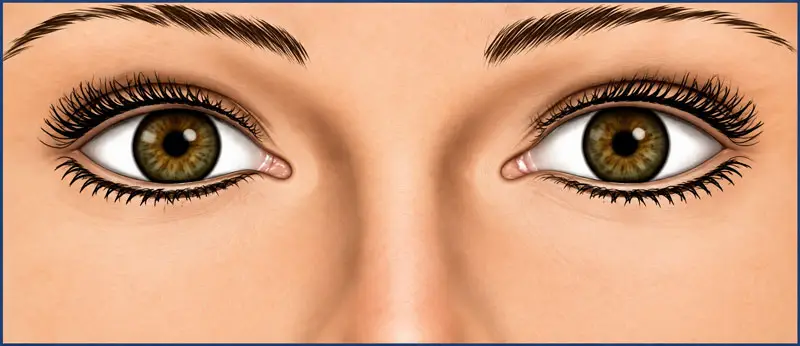
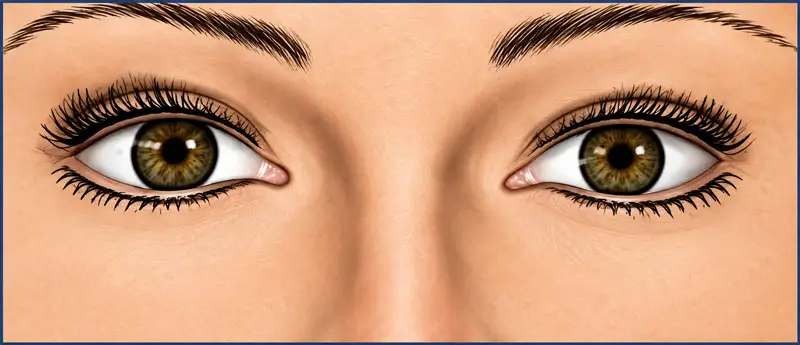
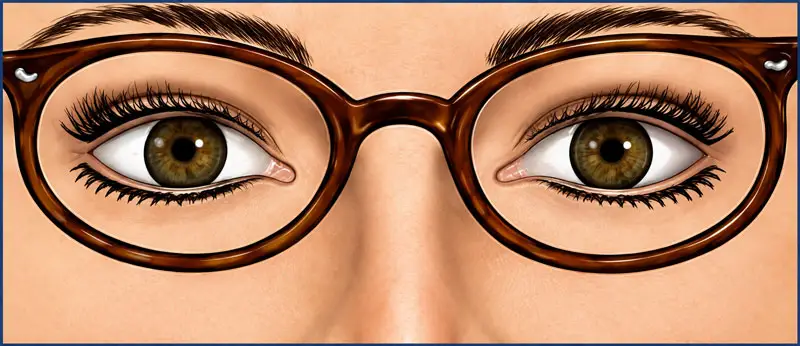
For a lid opening that is too narrow or too wide, a cylindrical lens, used alone or in combination with sphere lenses, will alter the apparent shape of the opening.
If the lid opening is too wide, place a minus cylinder over the prosthesis with the cylinder axis at 180°. Rotate the lens slightly in either direction to fine-tune the shape. For a starting point, begin with a -3.00 D cylinder. Adjust the rotation to achieve the desired effect. The use of a plus sphere can help counteract the minifying effect of the minus cylinder.
If the lid opening is too narrow, a plus cylinder placed with the axis at 90° will have the opposite effect, making the opening appear wider. Again, start with about +3.00 D and adjust the axis slightly to refine the shape. Adding minus sphere power may help neutralize this magnifying effect when needed.
Adjusting Orbit Height
Enophthalmic (sunken) eyes often result from lower lid sag due PESS (post enucleation socket syndrome) inferior orbital “blow-out” fractures, or orbital atrophy.
In these situations, a prism lens can be used to raise the apparent height of the orbit.
Each diopter of base-down prism will raise the apparent position of the eye by roughly 1.0mm. Because the prism adds significant weight, the frame choice is critical. An oversized frame will produce a thick, heavy edge and an unbalanced appearance. With proper frame selection, a prism can effectively elevate the orbit without compromising aesthetics.
Ocularists, particularly those working with a prosthetic patient, must be familiar with the principles and applications of cosmetic optics. Improved understanding and communication among all eye-care professionals are essential for achieving the best possible cosmetic and functional results.